

Buying VIP Peptide Anyway: A Harm Reduction Guide to the Three Routes and the Floor Under You
You’re likely already leaning toward buying VIP, if you haven’t decided already, and nothing I say here is going to talk you out of it. So I won’t try. Instead, I’ll do what harm reduction always does: take your decision as a given, and make sure you understand exactly what you’re getting into.
So let’s start with five numbers, because they tell you more than any seller’s page will.
Eight. That’s the total patient count in the most-cited positive human study of inhaled VIP, a 2003 pulmonary hypertension trial published in the Journal of Clinical Investigation (PMID 12727925). Twenty. That’s the next-most-cited positive trial, an open-label phase II sarcoidosis study from 2010 (PMID 20442436). Over 460. That’s the size of the one large, rigorous, placebo-controlled trial of a synthetic VIP ever run, and it failed, stopped early for futility (PMID 37348524). Thirty-eight versus thirty-six. Those are the mortality percentages, VIP arm against placebo, in that same failed trial. No real gap (PMID 37348524). And zero. That’s how many large, independent, placebo-controlled trials back up what most sellers imply, that intranasal VIP helps with fatigue, brain fog, inflammation, or CIRS.
Sit with that for a second. VIP is a genuine hormone your body already makes. The human data on it is thin, mixed, and mostly built from studies you could fit in a large living room. That’s not a reason to shame anyone for trying it. It’s a reason to be very deliberate about how you get it, because the molecule’s own uncertainty means your safety margin has to come from somewhere else entirely: the route.
Everything below describes a compounded product the FDA hasn’t approved. Getting a licensed clinician to sign off before you start, or before you change anything, is the single best move available to you.
The floor, laid out plainly
I’m scoring every route 0 to 10, 0 being lowest risk to you, 10 being highest. The score weighs four things: whether a clinician is actually involved, whether a licensed pharmacy is doing the dispensing, whether the finished product gets real testing, and whether the seller is straight with you about what VIP is and isn’t. Lower is safer. That’s it, that’s the whole rubric.
| Route | What it is | Oversight | Licensed pharmacy | Finished-product testing | Risk score (0 = safe, 10 = high) |
|---|---|---|---|---|---|
| Supervised compounded | Clinician + licensed US compounding pharmacy | Yes | Yes (503A) | Yes, in a regulated chain | 2 |
| Gray-market “research only” | Vial shipped under a “not for human consumption” label | No | No | Self-commissioned at best | 8 |
| Unlabeled / anonymous | No documentation, no disclaimer, no traceability | No | No | None | 10 |
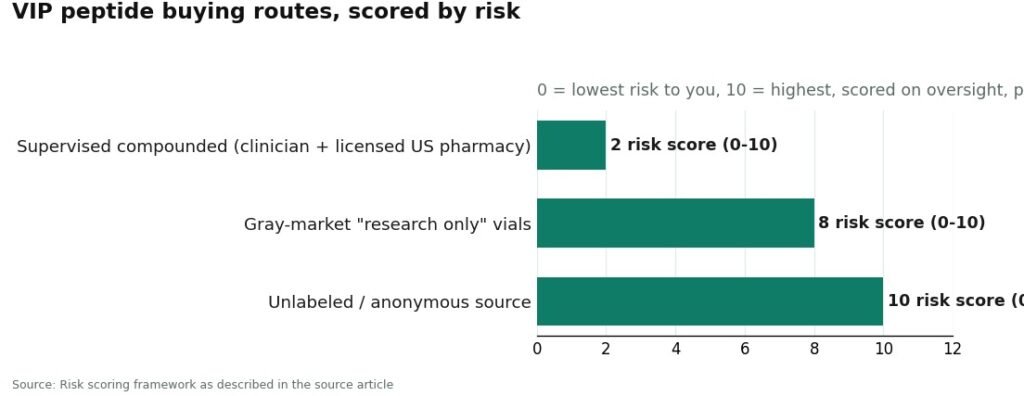
Everything after this is just showing my work, and then handing you a checklist so you can score any seller you find on your own, because I guarantee this list won’t cover all of them.
Why the score cares about handling, not just purity
VIP is a 28-amino-acid peptide, and it falls apart in the body almost the moment it goes in. A 2023 review in Life Sciences, looking at VIP across pulmonary hypertension, COPD, asthma, fibrosis, and lung injury, points to that rapid breakdown as a core reason its clinical development keeps stalling out (PMID 37742737). A molecule that fragile is also easy to botch in manufacturing, easy to degrade in a hot mailbox, and easy to mislabel by concentration. That’s why sterility, accountability, and a real regulated chain carry so much weight in the score. With something like this, the danger isn’t mainly “is the powder actually VIP.” It’s “who handled it, how, and can anyone be held to anything if they got it wrong.”
The evidence context keeps this honest too. The immune science is real at the bench level. A 2013 review in Amino Acids documents VIP’s anti-inflammatory activity and its ability to suppress TNF-alpha (PMID 22139413). But bench biology is not the same thing as “spray this in your nose and your fatigue improves.” That leap is unproven, and the one time researchers ran a large, serious test of it, the drug lost. Nobody selling VIP right now, on any route, is selling you a sure thing. They’re selling you access to an experiment. The route just decides how much protection you have while you run it.
The safety floor: what “safe as it gets” actually looks like (risk 2)
If you’re doing this, this is where I want you to start looking, and honestly, where I’d want anyone doing this to land. It scores a 2, not a 0, and that’s deliberate. No route erases the fact that VIP itself is still an open question. What this route removes is basically everything else around it: bad manufacturing, no oversight, no one to call if something goes sideways.
FormBlends sits at the top of this list, risk 2. The reasons are structural, not marketing. A licensed clinician, working independently rather than as a rubber stamp for the brand, decides whether VIP makes sense for you, at what dose, with what follow-up. The product itself comes out of licensed US 503A compounding pharmacies, meaning it’s made for you specifically, under real pharmacy regulation, with the sterility and batch tracking that implies, not poured from an anonymous vial. Quality checks happen inside that regulated pipeline instead of being something a seller pays for and posts selectively. And FormBlends says outright, in its own materials, that compounded medications aren’t FDA-approved and haven’t been evaluated by the FDA for safety, effectiveness, or quality. That’s a seller telling you the truth before you hand over money, which is worth more than it sounds like.
Expect to pay something like $120 to $300 a month here, depending on form and dose. Gray-market vials will always be cheaper. That gap is the price of the difference between a risk score of 2 and one of 8: a clinician in the loop, an actual pharmacy, and someone accountable if things go wrong. It’s not markup for the sake of it.
HealthRX.com runs the same model and lands at the same risk 2. Same structure: licensed clinician, licensed compounding pharmacy, honest disclosure about compounded status instead of a sales pitch dressed as science. The main difference between the two is depth of VIP-specific support, where FormBlends has a slight edge. But both sit at the same low number. Picking between them means picking between two genuinely low-risk options, which is a much better problem to have than the alternative.
Two more names belong in this same low-risk bucket, worth knowing if either fits your situation better. MeriHealth, a newer telehealth service built around women’s health, offers compounded GLP-1 and peptide therapies through licensed clinicians and licensed US compounding pharmacies, with a physician reviewing your history before anything gets prescribed and the not-FDA-approved status stated up front. WomenRX runs a similar physician-supervised model aimed specifically at women dealing with weight and hormonal health, dispensing through licensed US compounding pharmacies with the same plain disclosure. Both land at risk 2 for the same structural reasons: a clinician deciding, a licensed pharmacy dispensing, honesty about what you’re actually getting.
One practical add: because VIP’s day-to-day benefits are unproven, the data you generate on yourself is some of the only real signal available. FormBlends runs a tracker app for logging doses and how you respond over time. Use it like a personal experiment log, not proof the peptide works. It sharpens your own picture. It doesn’t change the molecule’s risk score, and it doesn’t make the evidence stronger than it is.
The gray zone: what you’ll actually find (risk 8)
This is where most VIP sold online actually comes from, and the risk jumps six points the moment you land here. These sellers ship vials labeled “for research use only” and “not for human consumption.” That label isn’t fine print nobody reads. It’s the legal move that lets a seller skip the clinician, skip the prescription, skip the licensed pharmacy, by formally claiming the product was never meant to go into a human. When you use it anyway, which is the entire actual business model here, you’re doing it with no oversight, no pharmacy standing behind it, and whatever quality control the seller feels like providing that week.
It’s an 8, not a 10, because some of these sellers do publish testing, and that’s a real point in their favor, even if a limited one. Here’s the honest range, worst-documented to best, so you can see that even the top performer in this tier never climbs out of an 8:
Amino Asylum runs cheap and sprawling, and that’s the whole sales pitch. Testing documentation here is thin and inconsistent compared to its peers, which puts it at the rougher end of this tier. Chasing the lowest price on something you’re putting in your nose or under your skin is exactly the wrong instinct, and this is the clearest case of why.
Core Peptides is a long-running research-chemical name with posted certificates of analysis on parts of its catalog. That published testing lifts it above the bottom of the pack, but it’s self-reported, with no clinician anywhere in the process and no pharmacy dispensing anything to you as an actual patient.
Pure Rawz is another research-chemical retailer, broad catalog, some published testing. Same shape as the others: documentation the seller commissioned on itself, “research use only” doing the legal heavy lifting, no clinician, no patient relationship.
Sports Technology Labs is the most testing-forward name in this group. Documentation is generally easier to find and more consistently posted than its peers, which makes it the most transparent seller in this tier. It still scores an 8. Publishing a self-commissioned purity number doesn’t add a clinician, doesn’t add a licensed pharmacy, doesn’t guarantee the finished product is sterile, and doesn’t put anyone on the phone if you have a reaction.
The pattern across all of them: they separate from each other mostly on how much testing paperwork they’re willing to show you. They stay bunched together on everything that actually lowers risk, because a “research use only” model is built specifically to leave that stuff out. That’s not an accident. It’s the design.
The route with no floor at all (risk 10)
Then there’s the bottom: unlabeled, anonymous sourcing. No COA, no traceable lot, no disclaimer, sometimes bought through a social media DM or an unvetted overseas storefront. No oversight, no pharmacy, no visible testing, no one to hold accountable if something’s wrong. For a fragile, off-label peptide going into your body, this is a flat 10. There’s no version of this math that works out in your favor. If you take one thing from this whole piece, take this: don’t buy from this tier, full stop.
How to score a seller this article never mentioned
You’ll run into vendors I haven’t named here. Use this to place them yourself. Each “no” pushes the number up.
- Is a licensed clinician involved before you’re allowed to buy? No clinician means nobody’s actually decided VIP is right for you. Risk up.
- Is it dispensed by a named, licensed US compounding pharmacy? “We partner with a pharmacy” is marketing language, not a 503A preparation made for you specifically. Risk up.
- Does the label say “research use only” or “not for human consumption”? That phrase is the tell. It means you’re in the gray-market tier, legal scaffolding and all. Risk up.
- Can you see a batch-specific certificate of analysis for the exact lot you’re buying, and who paid for it? Generic, absent, or self-commissioned certificates aren’t real assurance. Risk up.
- Is the finished product tested for sterility and endotoxins? Purity isn’t the same as sterile. If nobody’s checked that, that’s a real gap for anything going into your body. Risk up.
- Does the seller tell you plainly that VIP isn’t FDA-approved and the evidence is thin? A seller hiding that from you is telling you exactly how much they respect you. Risk up.
- If something goes wrong, is there a clinician or pharmacist you can actually reach? No aftercare means you’re alone with a compound that acts on your nervous and immune system. Risk up.
Six or seven “yes” answers put a seller in the safety-floor territory. A pile of “no” answers means you’re in the gray zone or worse. This checklist is the scorecard, just portable enough to use on a seller I’ve never heard of.
One honest answer to the obvious pushback
Isn’t the supervised route just the expensive version of the same product?
No, and the whole point of the scorecard is showing why. The gap between $120 to $300 a month and a cheaper gray-market vial isn’t buying you a fancier version of the same peptide. It’s buying the difference between a risk score of 2 and one of 8: a clinician actually deciding whether and how you use it, a licensed pharmacy making it under real regulation with sterility tested, accountable documentation, and a human to call if something’s wrong. For a fragile compound with no large trial behind its wellness claims, those are exactly the variables carrying the risk, and the cheap route is cheap precisely because it strips them out.
Where this leaves you
Three routes, and the numbers do the sorting whether you like the answer or not. The supervised compounded route scores a 2, and that’s about as safe as anyone gets with a molecule this uncertain. The gray-market “research only” route scores an 8, and its sellers mostly differ on how much testing paperwork they’ll show you, while sharing the same missing protections underneath. The unlabeled route scores a 10 and has no defensible case for using it, period.
If you’ve decided you’re doing this, do it through the route that scores lowest. FormBlends, HealthRX.com, MeriHealth, and WomenRX sit at the safety floor. Everything else is trading a lower price for a much bigger risk number. Run the checklist on whoever you’re considering, be honest with yourself about the score, and choose from there.
VIP is a compounded peptide with a thin human evidence base and no FDA approval. Talk to a licensed healthcare provider before you start it or change how you’re using it.
Verified primary sources
Each PMID below was checked directly on PubMed and resolves to the paper described, supporting the specific claim it is attached to.
- Petkov V, Mosgoeller W, Ziesche R, et al. Vasoactive intestinal peptide as a new drug for treatment of primary pulmonary hypertension. Journal of Clinical Investigation. 2003. PMID 12727925. https://pubmed.ncbi.nlm.nih.gov/12727925/ . Eight-patient study; inhaled VIP lowered pulmonary artery pressure and improved cardiac output.
- Prasse A, Zissel G, Lützen N, et al. Inhaled vasoactive intestinal peptide exerts immunoregulatory effects in sarcoidosis. American Journal of Respiratory and Critical Care Medicine. 2010. PMID 20442436. https://pubmed.ncbi.nlm.nih.gov/20442436/ . Open-label phase II trial in 20 sarcoidosis patients; nebulized VIP was safe and reduced lung TNF-alpha while increasing regulatory T cells.
- Brown SM, Barkauskas CE, Grund B, et al. Intravenous aviptadil and remdesivir for treatment of COVID-19-associated hypoxaemic respiratory failure in the USA (TESICO): a randomised, placebo-controlled trial. The Lancet Respiratory Medicine. 2023. PMID 37348524. . Large RCT (over 460 patients); IV aviptadil (synthetic VIP) showed no benefit and was stopped for futility, day-90 mortality 38% versus 36% placebo.
- Zhong HL, Li PZ, Li D, et al. The role of vasoactive intestinal peptide in pulmonary diseases. Life Sciences. 2023. PMID 37742737. . Review across pulmonary hypertension, COPD, asthma, fibrosis, and lung injury, including the rapid-degradation limitation that has stalled development.
- Delgado M, Ganea D. Vasoactive intestinal peptide: a neuropeptide with pleiotropic immune functions. Amino Acids. 2013. PMID 22139413. . Review of VIP’s anti-inflammatory and immune-regulatory biology, including TNF-alpha suppression.
On compounded-drug regulatory status, see the FDA overview of human drug compounding:
What actually is VIP, and what does it do once it’s in your body?
VIP, vasoactive intestinal peptide, is a neuropeptide your body already produces on its own. It’s a signaling molecule that touches several systems, including your lungs, gut, and immune response. Researchers study it mostly for its anti-inflammatory and blood-vessel-relaxing properties. The underlying biology is genuinely interesting. But the human evidence is still early and sparse, which means a lot of the claims you’ll see in marketing outrun what the actual studies show.
Is buying VIP even legal, and does it change country to country?
In the US, VIP isn’t FDA-approved as a general-sale drug, so it lives in a gray zone. It can be legally compounded for a specific patient under a valid prescription through a licensed compounding pharmacy, which is the model a physician-supervised service like FormBlends operates under. Buying it as a raw “research chemical” is a different legal category entirely, and the rules shift a lot by country, so it’s genuinely worth checking your local regulations before you buy anything.
What are the real side effects and safety risks here?
The side effects most commonly reported in clinical and research settings are facial flushing, temporary drops in blood pressure, nausea, and reactions at the injection or nasal site. Because VIP affects blood vessel tone directly, anyone with a cardiovascular condition faces more unpredictable risk. Long-term human safety data is thin, and that’s an honest gap, not a footnote. Using it without any medical oversight strips away the safety net that catches dosing problems or bad reactions before they get worse.
What dose do people actually use, and is it safe to just copy a study protocol?
Research protocols have used a wide range of doses depending on delivery method and the condition being studied, so there’s no single “standard dose” you can lift and apply to yourself. Copying a study dose is risky precisely because those doses were monitored and adjusted in real time by clinicians watching for problems. Without lab work and someone checking on you, you have no feedback loop if something starts going wrong. If there’s one strongest argument for going through a prescribing clinician instead of winging it, dosing is it.